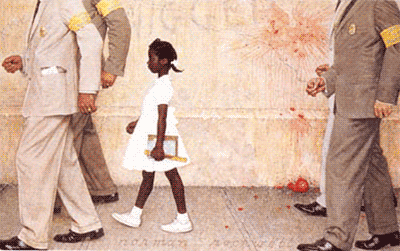
When Delpit wrote the article 'Skills and Other Dilemmas' her charge was "not to determine the best instructional methodology" as good teachers utilize a range of strategies. Rather she argued that the debate over instructional approaches "can lead to an understanding of the alienation and miscommunication, and thereby to an understanding of the 'silenced dialogue'" often experienced by teachers of color. The 'culture of power' is relevant to the schism between liberal educational movements and that of non-white, non-middle class teachers and communities.
That "culture of power" includes five aspects, the first three being as Delpit explains, tenets in the literature surrounding the sociology of education: 1) issues of power are enacted in the classroom; 2) there is a 'culture of power', that is the codes for participating in power; and 3) rules of the culture of power are a reflection of the rules of the culture of those who have the power.
The third and fourth I found to be especially enlightening. Delpit's fourth is, "If you are not already a participant in the culture of power, being told explicitly the rules of that culture makes acquiring power easier". She gave an example about going to an unfamiliar culture and preparing oneself by learning their codes about appropriate dress and communication styles. She contends that "it is much he same for anyone seeking to learn the rules of the culture of power." She is right! Teachers need to be the travel tour guide or the Peace Corps staffer whose job it is to prep adventurers before they enter a new land and culture that is strange to them.
Next, Delpit's fifth aspect of the 'culture of power' is that "those with power are frequently least aware of - or least willing to acknowledge - its existence. Those with less power are often most aware of its existence." Although many whites do not perceive themselves as having power, considering that most of us 'struggle up' we at least need to be aware of what others may perceive.
By acknowledging such power we then can explicitly communicate this with learners and support them in breaking the codes. We can have real conversations and truthful dialogues that based on my experiences, are so appreciated by adult and late-teen learners. This lack of acknowledgement or unwillingness perhaps, is a weak attempt to lessen the power differential and used to help to assuage white guilt. Unfortunately the outcomes of such implicit and coded teaching hurts learners. After all learners are not in class to help white middle class teachers deal with issues of guilt which may be the only false/semi-positive outcome of such indirect instruction, and even that is questionable!
Wednesday, June 2, 2010

Introduction
My first blog was about the IAT so this is my second blog... oh wait! I guess this is a 'posting' or is it a 'post', not a blog?
Yeah, surprise, I have no experience with blogging and its lingo is foreign to me. I had no idea that this would be a tech-driven class. I fear that the tech side will continue to overwhelm me to the point that it negatively impacts my academic perfrmance in spite of my doing the work that makes up the content of the class. Actually, I'm late with postings or posts so it may already have done just that.
My plan is to take the technology class required of the TESL master's program next semester. Maybe that should be a prereq. for this class? Who knows.
If is survive this class I will be just beyond the half-way point to my MEd. in TESL. I have experience in teaching adult ESL in academic and workplace environments as well ABE - adult basic education. Previously I worked in human resources and training and later applied those skills in community based organizations and at CCRI in various educational programs.
Yeah, surprise, I have no experience with blogging and its lingo is foreign to me. I had no idea that this would be a tech-driven class. I fear that the tech side will continue to overwhelm me to the point that it negatively impacts my academic perfrmance in spite of my doing the work that makes up the content of the class. Actually, I'm late with postings or posts so it may already have done just that.
My plan is to take the technology class required of the TESL master's program next semester. Maybe that should be a prereq. for this class? Who knows.
If is survive this class I will be just beyond the half-way point to my MEd. in TESL. I have experience in teaching adult ESL in academic and workplace environments as well ABE - adult basic education. Previously I worked in human resources and training and later applied those skills in community based organizations and at CCRI in various educational programs.
Wednesday, May 26, 2010
The IAT and Me
The IAT
The results from the IAT were intriguing. My 'preferences' or should I say alleged preferences (so yes, I am a bit defensive on this) were stronger than I imagined they would be.
Test results put me with the majority, the 48% who strongly preferred or identified with European Americans. I may take the test again now that I better understand what I was supposed to do when first facing the four options part of the test. I was a bit unclear on the directions at the start of that portion.
That being said, I'm not entirely surprised by my results. I am a product of my environment. I grew up in Barrington where for a while we were the 'others'. Those from the Italian section of town (back when there truly was such a place) were thought of as a minority and as less white. Many in that community bought into and perpetuated the same. Fitting in and being more white was one of the options presented to us and often the only one that we saw. Therefore, emphasizing my whiteness and NOT my ethnicity in my community and by extension in my home was imperative.
Subscribe to:
Posts (Atom)
